
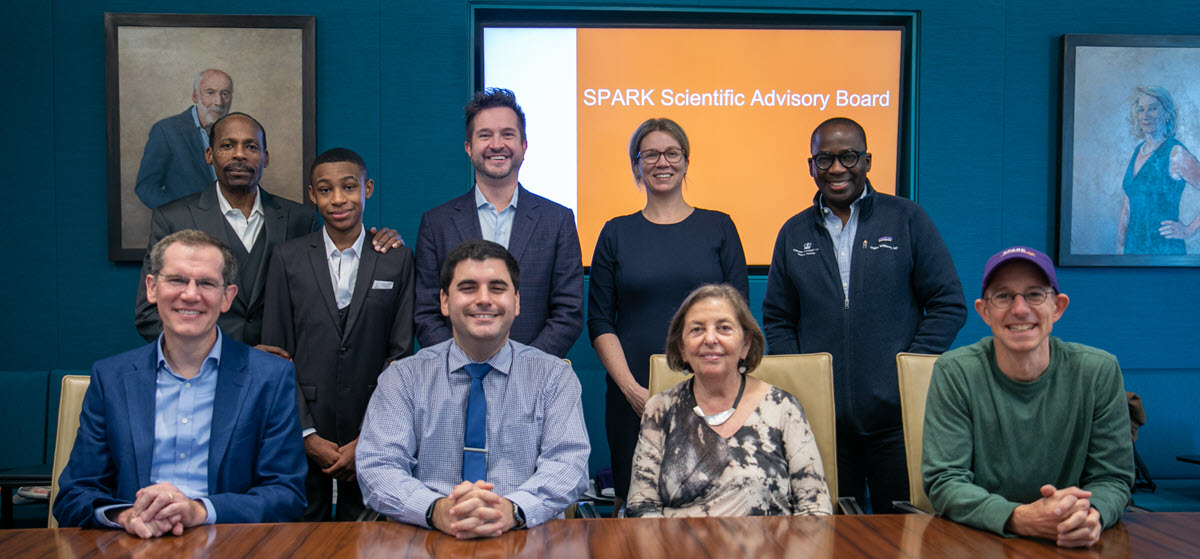
Meet Our Scientific Advisory Board
Date Revised: April 3, 2025
 Raphael Bernier, Ph.D., is currently a scientist at Apple, Inc. He was formerly the William J. and Lydia N. Gumerman Endowed Chair in Child Psychiatry at the University of Washington and the Executive Director of the Seattle Children’s Autism Center. As a clinician and the author of multiple scientific articles and books, his academic research focused on the intersection of genetics, neuroscience and clinical care associated with neurodevelopmental disorders. He has served as associated editor of Autism Research, board member for the International Society of Autism Research, the Autism Science Foundation, and on the scientific advisory panels for the Simons Simplex Collection, the ADNP Foundation, the GRIN2B Foundation, and others.

Jorge E. Chavarro, M.D., Sc.D., is Professor of Nutrition and Epidemiology at the Harvard T.H. Chan School of Public Health and Professor of Medicine at Brigham and Women’s Hospital and Harvard Medical School. He completed his medical training at the National University of Colombia and subsequently completed graduate studies in Nutrition and Epidemiology at Harvard, where he also completed a post-doctoral research fellowship before joining its faculty. Dr. Chavarro’s research focuses on understanding how nutritional, lifestyle and metabolic factors impact human reproduction and reproductive milestones throughout the life course, and how these events, in turn, impact other aspects of health. Over the last decade, this broad interest has focused primarily on understanding how nutrition impacts human fertility and health during pregnancy. Dr. Chavarro has conducted a variety of studies among healthy individuals and among couples undergoing infertility treatment domestically and abroad. He is Principal Investigator of the Nurses’ Health Study 3, an ongoing prospective cohort study that follows more than 50,000 women. He also leads the nutritional component of the EARTH Study.
 Elise Robinson, Sc.D., is an Assistant Professor in the Center for Genomic Medicine and Department of Psychiatry at Massachusetts General Hospital and an Institute Member of the Broad Institute of Massachusetts Institute of Technology and Harvard. She is also an affiliated faculty member with the Analytic and Translational Genetics Unit at Massachusetts General Hospital. Robinson’s research focuses on the genetic epidemiology of behavior and cognition. She is interested in using genetic data to understand the biology of neurodevelopmental variation, and to study differences within and between neuropsychiatric disorders. She co-chairs the Autism Working Group of the Psychiatric Genomics Consortium, and the Program in Neurodevelopmental Disorders at the Broad Institute. The Robinson lab uses techniques from statistical genetics and epidemiology to study how common and rare genetic risk factors for severe neuropsychiatric disorders may differ, and develops approaches for examining these questions in large samples.
Robinson received a Sc.D. in psychiatric epidemiology from the Harvard School of Public Health, and completed postdoctoral training in statistical genetics at Massachusetts General Hospital and the Broad Institute.
 Laura Schulz, Ph.D., is the Associate Department Head and the John and Dorothy Wilson Professor of Cognitive Science in the Department of Brain and Cognitive Sciences at MIT. She graduated from the University of Michigan with a degree in philosophy and from the University of California, Berkeley with a Ph.D. in developmental psychology. Her research focuses on the problem of induction: how children learn so much from so little so quickly. She and her students have worked on a wide range of topics including causal reasoning, play and learning, and social cognition. Work in her lab is influenced by computational models of cognition and she is especially interested in bridging the gap between formal models of learning and children’s behavior. She has been honored with the American Psychological Association Distinguished Scientific Award for Early Career Contributions to Psychology, the Society for Research in Child Development Award for Early Career Contributions, the Troland Award from the National Academy of Sciences, and the Presidential Award Early Career Award for Scientists and Engineers.
 Helen Tager-Flusberg, Ph.D., received her BSc. in Psychology from University College London, and her Ph.D. in Experimental Psychology from Harvard University. Since 2001 she has been at Boston University, where she is now Professor Emerita of Psychological and Brain Sciences, and Director of the Center for Autism Research Excellence. She has devoted her career to conducting research on ASD and other neurodevelopmental disorders exploring variability in phenotypic expression investigating developmental and intervention-based changes in language and social cognition using behavioral and brain imaging methodologies, and developing new measures to assess language across the full range of the autism spectrum. Her research has been funded by the National Institutes of Health, other federal agencies, and private foundations. She has edited seven books and written over 300 journal articles and book chapters. She is the Past President of the International Society for Autism Research (INSAR: 2011-2013) and received the INSAR Lifetime Achievement Award in 2021 for her lasting contributions to research on autism. She is currently a member of the United States Federal Inter-Agency Autism Coordinating Committee (IACC). She regularly presents her work at scientific and professional conferences and to advocacy groups, parents and other stakeholders in the US and in countries around the world.

Judith Ursitti spent a decade working in the world of tax accounting as a Certified Public Accountant. After her son’s autism diagnosis, she became immersed in advocacy, working in state government affairs at Autism Speaks for more than thirteen years and then at leading government affairs at the Council of Autism Service Providers.
She cofounded the Profound Autism Alliance in 2022 to focus on the heath and connection of autistic people who need lifetime, 24/7 care.
 Olajide Williams, M.D., M.S., is a Professor of Neurology and Vice Dean of Community Health at the Columbia University Vagelos College of Physicians and Surgeons. He is also Vice Chair of the Department of Neurology and a specialist in the treatment of stroke and cerebrovascular diseases. Williams is an attending physician at NewYork-Presbyterian Hospital and a clinical neurologist at Columbia University Irving Medical Center. He attained his medical degree from the University of Lagos, Nigeria, and completed his neurology residency and neuromuscular fellowship training at The Neurological Institute of New York. Williams also holds a Master of Science degree from the Columbia University Mailman School of Public Health. Williams is a world-renowned leader in stroke disparities and community-based behavioral intervention research. He is founder and chair of Hip Hop Public Health, an internationally-recognized organization that creates and implements multimedia public health interventions that target and engage young people in the health of their families and communities.
 Zack Williams, Ph.D., is an autistic medical student in the Vanderbilt University School of Medicine and recent graduate of Vanderbilt’s Ph.D. program in Neuroscience. He is also an affiliate of the Vanderbilt University Frist Center for Autism and Innovation, Vice-chair of the Autism Intervention Research Network on Physical Health (AIR-P) ANSWER Committee, and former chair of the INSAR Autistic Researchers Committee. He is also a SPARK participant (along with his mother), as well as a frequent user of SPARK Research Match from both the researcher and participant sides. Zack’s research focuses on the sensory manifestations of autism in adulthood, the assessment and treatment of co-occurring physical and mental health problems in autistic adults, and the development of novel questionnaires and clinical measures to assess core and associated features of autism across the lifespan. As a psychiatrist-in-training, he hopes to specialize in the treatment of autistic adults with mood disorders and additional mental health conditions, working to develop evidence-based treatments and care pathways for this specific population. You can follow him on Twitter at @QuantPsychiatry.